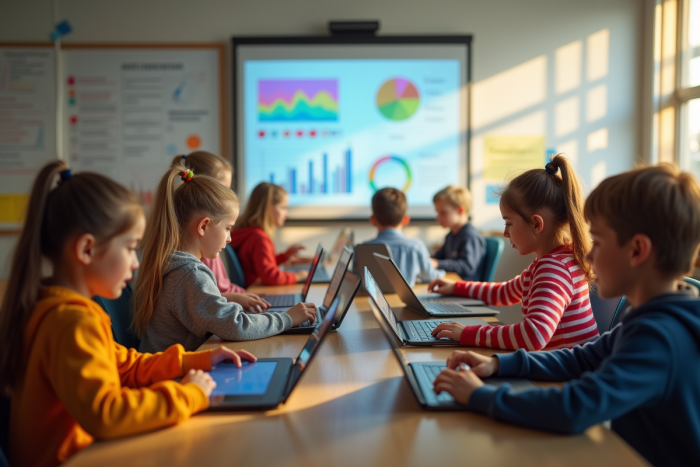
The certification of digital skills has become mandatory for all students at the end of cycle 4 since 2019. However, less than 60% of institutions currently comply with this protocol within the expected deadlines. The use of digital technology in schools is no longer limited to access to resources: it is now about developing critical and responsible know-how, measured according to specific criteria.
From collaborative platforms to automated assessment tools, new devices are being adopted at disparate rates and with uneven results. The digital transition in middle schools is progressing, but it raises questions about equal opportunities and the relevance of the chosen solutions.
Digital Skills in Middle School: What Challenges for Today’s Students?
Digital technology has radically changed the face of middle school. In just a few years, it has not only made its way into classrooms: it has established itself as one of the cornerstones of national education, from official programs to concrete uses. At stake is a certification of digital skills, Pix, which has become a necessary step at the end of cycle 4. Beyond validating skills, this system aims to instill reflexes: to act with discernment, understand the rules of a connected universe, and develop a critical relationship with information and tools.
Driven by the Ministry of National Education, this transformation engages every institution: it is about supporting students in acquiring a robust foundation, clearly defined by the framework of digital skills (CRCN). However, the reality on the ground shows disparities: less than 60% of middle schools are keeping pace with the timeline set for digital skills certification. One of the major challenges is to ensure a pedagogical continuity everywhere, preventing the digital divide from widening further. This requires the active involvement of digital referents and targeted investments in appropriate resources to meet the expectations of the framework.
In practice, students must learn to navigate the Internet, sort information, and collaborate remotely: these skills have become essential in today’s society. But mastery of digital technology is not limited to manipulating tools: it involves a demanding media and information literacy education, emphasizing analysis, critical thinking, and online safety. To support this journey, solutions like MBN provide solid and recognized support.
The middle school, as a crossroads between primary school and high school, is entrusted with the mission of anchoring these new benchmarks. The success of this collective ambition depends on the ability to train clear-sighted, autonomous adolescents capable of adapting to a changing digital universe and staying ahead of its developments.

Overview of Essential Digital Tools and Resources for Thoughtful Learning
In middle schools, a wide range of digital tools now shapes the daily life of students and teachers. Interactive whiteboards change the game: they allow for projecting documents, annotating in real-time, and engaging students on the spot. The classroom atmosphere becomes more lively, oral expression is stimulated, and collective experimentation is encouraged.
Another major advancement is the digital work environment (ENT), now widespread. It serves as the backbone of pedagogical life: remote assignments, internal messaging, centralized access to resources, shared calendars… The ENT simplifies the flow of information, encourages pedagogical continuity, and fosters the autonomy of middle school students, a key step in their education.
Educational applications and classroom management platforms complement this ecosystem. They offer differentiated pathways, tailored to the pace and level of each student. In practice, this translates into personalized training, interactive quizzes, automated corrections, and detailed tracking of progress.
Training in social media and artificial intelligence is now part of the school curriculum. In the face of an abundance of information, students must learn to sort, verify, and argue: essential reflexes for navigating the digital world and avoiding its pitfalls. Developing real digital skills thus requires both mastering the tools and cultivating a critical, clear-sighted, and vigilant approach.
Here’s what these educational technologies concretely enable:
- Educational technologies sustainably transform pedagogical practices and the classroom experience.
- Mastery of reference tools prepares students for the next steps in their journey, both in high school and in professional life.
The results are evident: France shows performance above the international average in the use of educational digital technology, proving that these tools occupy a key place in middle school education. The momentum is underway. The challenge now is to amplify it, so that every student, regardless of their background, can fully benefit from this silent revolution.