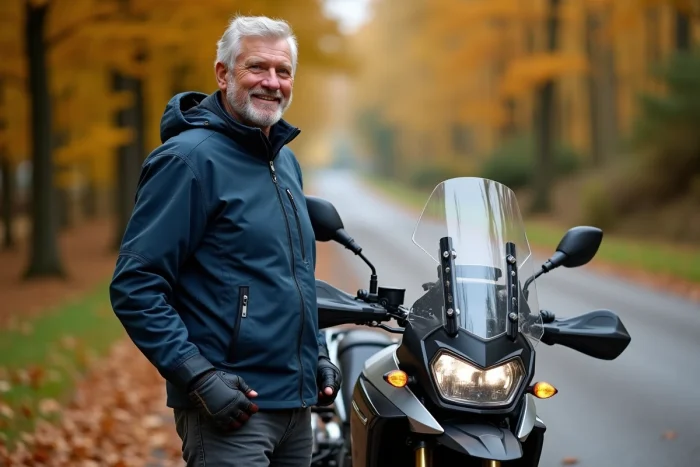
What objective criteria distinguish a motorcycle suitable for a rider over 60 from an off-road or sports motorcycle? Weight, seat height, electronic aids, and insurance costs form a measurable set. This article compares these parameters to identify the segments that meet the physical and budgetary constraints of senior riders.
Electronic Aids and Passive Safety on Motorcycles for Seniors
The severity of injuries significantly increases with age among motorcyclists, according to the ONISR 2023 report on the accidents involving motorized two-wheelers (published in June 2024, chapter “Age of Drivers”). This finding directs the choice towards models where electronic aids compensate for the loss of reflexes.
Manufacturers are now widely implementing cornering ABS, fine traction control, rain modes, hill start assist, and sometimes blind spot radar on mid-size trails and mid-displacement touring bikes. The French Federation of Angry Motorcyclists (FFMC) noted in its “Motorcycle and Aging” report published in 2023 that these mid-size segments are very popular among those over 55.
Choosing the best motorcycle for seniors is therefore less about aiming for maximum power and more about checking for the presence of these standard features, which can vary greatly from model to model within the same range.
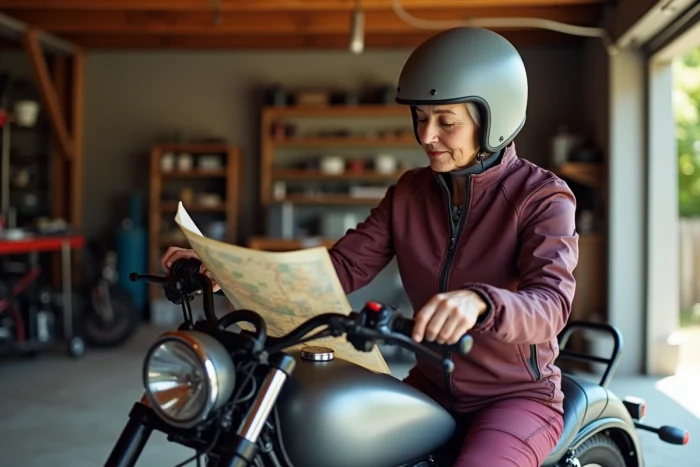
Comparison of Motorcycle Segments Suitable for Retired Riders
Three families of motorcycles frequently come up in discussions among senior riders: mid-size trails, comfort touring bikes, and three-wheeled scooters. The table below summarizes their main characteristics.
| Criterion | Mid-size Trail | Comfort Touring | Three-wheeled Scooter |
|---|---|---|---|
| Riding Position | Upright, relaxed arms | Semi-reclined, forward footrests | Upright, flat floor |
| Seat Height | Medium to high (often adjustable) | Low to medium | Low |
| Weight in Running Order | Moderate | High (e.g., Gold Wing) | Moderate to high |
| Cornering ABS / Traction | Common as standard | Common as standard | Varies by model |
| Passenger Comfort | Acceptable with extended seat | Very good (backrest, footrests) | Limited |
| Low-speed Maneuverability | Good | Average (weight) | Very good (stability at a stop) |
The comfort touring bike (Honda Gold Wing, Indian Pursuit, Harley-Davidson Street Glide) dominates for two-up long-distance travel. However, its weight makes it tricky to maneuver in parking situations or on narrow mountain roads.
The mid-size trail offers the best compromise between maneuverability and safety features. The three-wheeled scooter appeals to seniors who are getting back on the handlebars after a long break, thanks to its natural stability at very low speeds.
Physical Adaptations and Motorcycle Ergonomics for Those Over 60
Motorcycles and scooters specifically adapted to the physical limitations associated with aging are beginning to be offered in France: rear-set controls, lowered seats, and thicker grips explicitly targeting riders over 60.
These adaptations are not just gimmicks. A handlebar that is too low forces cervical flexion, which exacerbates back pain. A seat that is too high prevents flat-footing, creating instability at every stop. The elements to check before purchase form a short but decisive list:
- Seat height allowing both feet to be flat on the ground, possibly with a factory-lowered seat or an option
- Weight in running order compatible with the ability to lift the motorcycle alone in case of a fall at a stop
- Width and thickness of grips, adjustable via ergonomic grips if hand strength decreases
- Position of the footrests (forward or mid) to limit knee flexion on trips longer than an hour
A test ride at a dealership is not always sufficient. Riding for at least thirty minutes on open roads helps detect muscle tension that five minutes of parking does not reveal.
Senior Motorcycle Insurance: A Lower Cost than Car Insurance
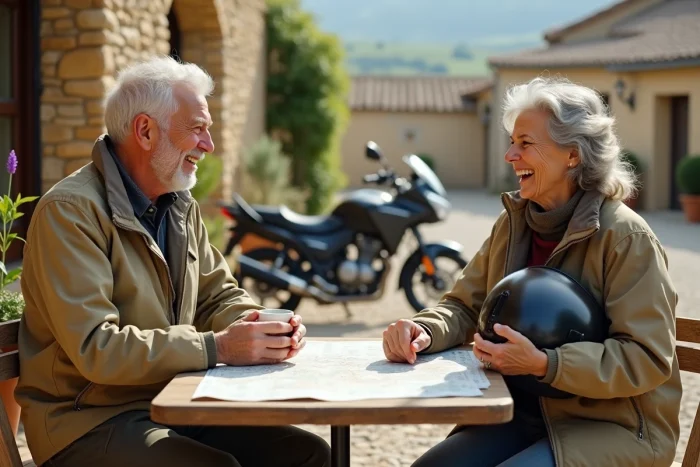
The increase in motorcycle insurance costs for those over 65 remains limited compared to car insurance. Some companies even offer reduced rates or deductibles for former riders getting back on the bike, provided they take a refresher course.
This point deserves attention because it reverses a common misconception. For cars, insurance premiums significantly increase after age 70. For motorcycles, the profile of “experienced rider returning” often benefits from a bonus related to the longevity of the license, even after several years of interruption.
Refresher Course and Insurance
Taking a post-license or refresher course sometimes opens access to more favorable pricing conditions. This course also allows testing one’s physical endurance over a full day of riding, which serves as a real-world test before purchase.
- Check with the insurer if a recognized course qualifies for a deductible reduction
- Compare specific “return to riding” offers between specialized motorcycle insurers and general insurers
- Request a quote specifying the age of the A license, even if the last motorcycle was several years ago
The overall budget for a retirement motorcycle is not limited to the purchase price. Insurance, maintenance, and protective gear (helmet, back protector, reinforced gloves) form a recurring expense. Considering the complete annual cost avoids unpleasant surprises after a few months of riding.
The choice of a motorcycle for retirement is based on measurable data: weight, seat height, presence of standard electronic aids, and insurance conditions. Senior riders are not the most accident-prone according to ONISR, but the severity of injuries increases with age. Prioritizing active safety and ergonomics remains the most significant factor in the equation.