
Nothing prevents one from getting lost in a digital corridor, especially when a poorly entered identifier or an obscure internal instruction blocks all access to the tool. In a hospital, every minute counts; every missed click can turn a morning into an obstacle course. Arriving on a new platform like Octime Courlancy is never just about opening a simple account: it is sometimes a test of patience, often a necessary step for the entire team.
Solutions such as Octime Courlancy have pushed the requirements further: they combine security, simplicity, and adaptability, taking into account the specific constraints of each department. Adopting this type of platform means gaining efficiency for the entire organization, streamlining daily management, and avoiding the pitfalls of sluggish information flow.
What are management platforms like Octime Courlancy used for in a hospital or educational institution?
In the hospital world, organizing schedules is not just about checking boxes. It is the foundation that keeps a department running, ensures continuity of care, and meets regulatory obligations. Octime Courlancy, like other management platforms, is not just a tool: it is the invisible architecture that structures daily life. Its reliability, the quality of the connection, all of this impacts the performance of the service.
Thanks to the Octime Courlancy employee connection, access becomes centralized and the flow of information accelerates. Rights are personalized, the interface is designed to prevent errors: everyone can instantly find their schedule, their tasks, their pending requests. Managers, on the other hand, maintain control over everything, adjust teams, and anticipate needs.
In a hospital or a school, this digital platform becomes a tool for optimization in its own right. It notably allows:
- to reduce scheduling conflicts,
- to ensure the tracking of replacements,
- to react quickly to unforeseen events.
Management ceases to be a heavy burden and becomes a lever for efficiency and safety, both for staff and for patients. In the face of the digital transformation of institutions in France, the adoption of these tools reshapes daily life, from the care service to support functions.
How to successfully connect for the first time as an employee at the polyclinic: steps, tips, and solutions to common blockages
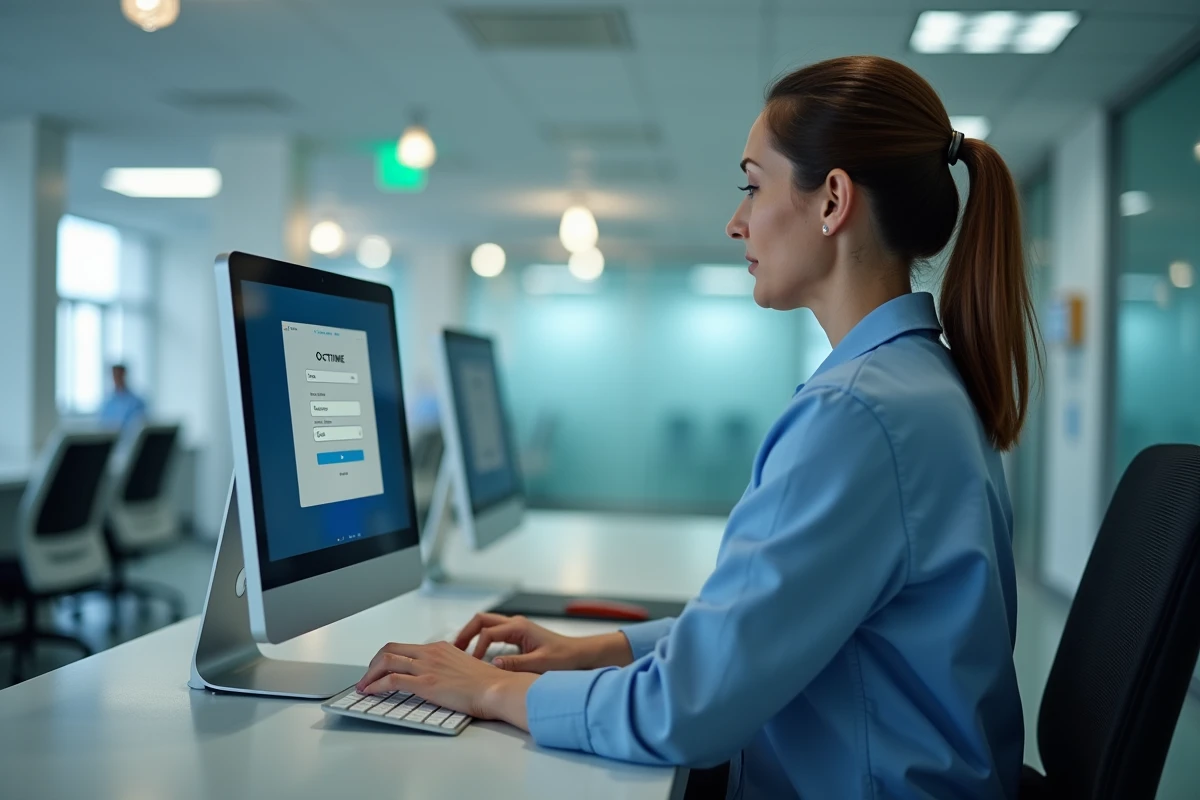
Discovering Octime Courlancy for the first time is entering a space designed for organizational flexibility. Newcomers to the polyclinic must equip themselves with their personal identifier provided by human resources, accompanied by a temporary password. This precious key, obtained during a training session or via secure mail, opens access to the platform.
The connection is made directly online, from any device: computer, tablet, or smartphone. Simply go to the dedicated page, accessible via the link provided by management or available on the polyclinic’s intranet. One point not to be overlooked: a reliable internet connection is essential for the interface to function smoothly.
In case of difficulty, unresponsive page, access denied, forgotten password, support is never far away. The “forgot password” function or contacting the IT department allows for a quick resolution. A few reflexes can avoid many inconveniences:
- Check that the identifier is entered correctly (pay attention to uppercase letters and special characters).
- Use an up-to-date browser to ensure compatibility.
- If the interface freezes, clearing the browser cache often resolves the issue.
Security remains paramount: the temporary password must be changed upon first connection, for a strong and confidential combination. Never share your access. This protocol protects data confidentiality and ensures smooth organization for all employees of the polyclinic.
Going further with the ERP: digital tools to simplify life in hospitals and education
Digital has infiltrated every corner of daily life, whether within the Courlancy polyclinic or behind the doors of a classroom. The ERP, this integrated management software, orchestrates all processes and data of an institution. Its goal: to automate repetitive tasks, ensure reliable information transmission, and provide a detailed analysis of activities.
For hospital teams, these connected solutions change the game. Modifying a schedule, reporting an absence, adjusting a team: everything happens in real-time, at the click of a button, on an interface designed for ergonomics and security. The design of these tools aims to limit errors and secure the exchange of sensitive data.
The principle also applies to education. The criteria for choosing a platform revolve around the centralization of information, the personalization of pathways, and support in skill development. Whether in Paris, the Hauts-de-Seine, or Saint-Étienne, these digital environments are essential where the complexity of organizations calls for reliable and adaptable tools.
Here are the main advantages highlighted by users:
- User experience: intuitive navigation, access tailored to each profile.
- Security: continuous access control, traceability of operations.
- Optimization: time savings, fairer distribution of resources.
Deploying this type of solution requires rethinking data management and strengthening ongoing training. For everyone to master these tools, question them, and adopt a vibrant digital culture, it is necessary to open the door to participation and collective evolution.