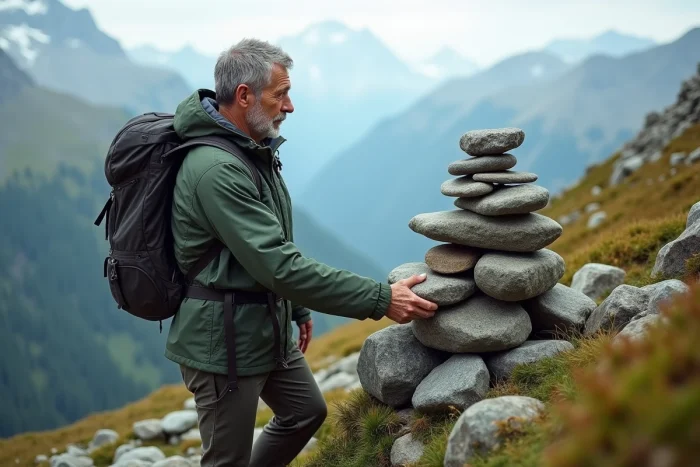
A structure of stacked stones can signal a sacred territory in Mongolia, an ancestral tomb in Scotland, or simply a landmark on an alpine trail. In some Scandinavian countries, adding a stone to an existing pile is still practiced, without any official guidelines ever imposed. Authorities in some national parks now prohibit their construction, citing risks to the environment and safety.
The use, meaning, and symbolism of these mounds vary from continent to continent and span the centuries, encompassing funerary practices, spiritual beliefs, and discreet landscape marking.
Stone Cairns: Origins and Evolution of an Ancient Tradition
Since the Neolithic era, cairns have dotted the landscapes of northwestern Europe and well beyond. These stacks of stones tell an ancient story, where each society has given them a specific function: to indicate a territory, to pay tribute to those who have passed, or simply to provide a marker for travelers lost in the vastness. The Barnenez cairn, erected in Brittany at a time when dolmens and stone circles had not yet emerged, embodies this memory of stone, solid and stubborn against time. On the Isle of Skye, at Clava in Scotland, or in the basalt deserts of Iceland, these mineral sentinels can be found, always there to guide the steps of a walker.
The same principle, but a multitude of variations. Depending on the places and times, the cairn changes its face: grave, ritual monument, simple marker planted at the edge of a field or at the tip of a peninsula. Archaeologists sometimes discover bones beneath these mounds, sometimes not; the function varies, but the stone remains. In support, the meaning of stone cairns continues to feed research, straddling collective memory and practical use. Their definition has been shaped over the centuries, molded by the lives of rural and nomadic societies, from Scotland to the plateaus of France, from the Icelandic fjords to the Breton moors. Whether they testify to a passage or recall a forgotten cult, cairns traverse time, bearing stories, beliefs, and that human stubbornness to leave a trace, even mineral, on the earth.
Why are Cairns So Fascinating Across Cultures and Eras?
In each cairn, one can sense the mark of a presence. These structures, erected from northern Europe to the Asian steppes, vary in size, shape, and use. But all draw an invisible line between what is concrete and what touches the invisible. It is in this friction between the builder’s hand and the stone’s duration that the strange fascination exerted by cairns is born.
Stacking stones is an act of memory. For some, it is to mark a path, signal a passage, or quietly mark a territory without noise or signs. For others, it is a meditative gesture, close to zen, where fragile balance defies gravity and the present moment. Some even see it as an offering, a silent wish, a discreet dialogue with the natural world.
The most recent cairns, sometimes tiny, reveal a desire to intervene without imposing, to leave a discreet imprint on the landscape. But their diversity far exceeds this contemporary trend. Each culture has managed to invent its own way of giving meaning to these mounds of stones, weaving an intimate relationship with the environment. The very word cairn, whose Celtic root refers to the human, speaks of this proximity: a presence that watches over, a memory that perpetuates, discreet yet tenacious.

Symbols, Current Uses, and Iconic Examples Around the World
From Nordic ridges to Asian deserts, from beaten paths to national parks, cairns adapt to all cultures and landscapes. One word summarizes them: versatility. They take on multiple roles, of which here are some concrete examples:
- mark the mountain,
- structure the landscape,
- bear the trace of a silent passage.
In the collective imagination, the pile of stones takes on the value of a sign. In the far west, the monumental Barnenez cairn recalls the architectural mastery of the first builders. On the trails of the Himalayas, stone stacks serve as guides, protect travelers, and sometimes greet the spirits of the summits. Closer to us, in the Val de Bagnes, shepherds used cairns to organize grazing spaces and exchange simple messages.
The practice continues to evolve. Today, some stack stones in national parks, sometimes as a trend, raising debates about nature preservation. The question arises repeatedly: does this gesture help or disrupt the landscape? From the Barnenez tumulus to the debris of the Matterhorn, the cairn brings together walkers, locals, and passing visitors. Always, the stone connects memory to territory, between ancient heritage and today’s gesture, like a silent handshake, from generation to generation.