
Nocibé is one of the few selective perfumery networks born outside of Paris that has achieved national and then European scale. Founded in 1984 in Lille by Daniel Vercamer, the brand takes its name from the Malagasy island of Nosy Be, known for its production of ylang-ylang, a raw material for fine perfumery. This toponymic choice is not anecdotal: it anchors the brand’s positioning at the crossroads of care, fragrance, and plant-based well-being.
Nocibé and the relational model in-store facing AI
Personalized advice in-store is the historical pillar of Nocibé. From the very first Lille boutiques, Daniel Vercamer bet on an open format where customers can freely handle products, assisted by advisors trained in selective ranges. This relational model has long differentiated the brand from traditional perfumeries with closed counters.
The arrival of digital pure players, capable of offering automated skin diagnostics and algorithmic recommendations, raises a structural question. AI threatens less the advice than the perception of its added value: a customer used to receiving a personalized routine in three clicks on an app may find the trip to the store unnecessary.
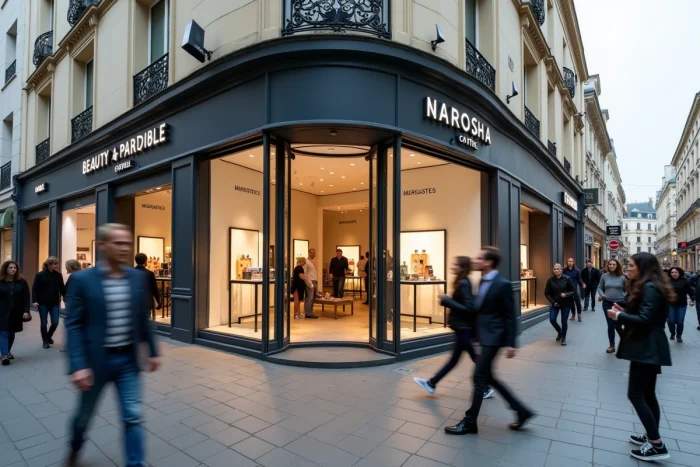
We observe that physical brands that resist the most integrate AI as a sales assistance tool for advisors, not as a substitute. A skin diagnosis performed by a sensor in-store, interpreted by a saleswoman who knows the catalog, creates a hybrid experience that is difficult to replicate online. To discover who owns Nocibé and understand the strategic choices related to this shift, one must look back at the successive changes in ownership.
The real risk for Nocibé is not technological. It lies in under-investment in staff training in the face of tools that evolve every quarter. A network of several hundred points of sale must synchronize the digital skill enhancement of thousands of advisors, which represents a logistical as well as financial challenge.
Daniel Vercamer and Nocibé’s northern anchoring strategy
The Lille establishment of Nocibé is not a mere geographical coincidence. Daniel Vercamer exploited a dense regional commercial fabric, with medium-sized city centers where selective perfumery remained dominated by loosely structured independents. Opening in the North before moving down to Paris reversed the usual logic of French retail.
The territorial network preceded national notoriety. This bottom-up strategy allowed the brand to test its concept in real conditions, adjust its assortments, and train its teams before facing Parisian competition. The headquarters remained in Lille, a choice that reflects a decentralized corporate culture.
The very name of the brand, inspired by Nosy Be and its floral essences, served as a strong identity marker in a market where competitors opted for more generic names. The evocation of a tropical island created an immediate sensory imagination, easy to remember and associate with olfactory pleasure.
Acquisitions and successive owners of Nocibé
The capital history of Nocibé reads like a succession of growth stages linked to changes in ownership. After a phase of organic development under the leadership of its founder, the brand attracted the attention of international funds and groups seeking to consolidate the fragmented market of French selective perfumery.
Douglas Holding, a German perfume distribution group, became the reference shareholder. This acquisition integrated Nocibé into a European network of several thousand points of sale, altering the supply logic, listings, and private label policy.
The integration within Douglas had direct operational consequences:
- Partial harmonization of ranges with the group’s European catalog, reducing the latitude of French buyers regarding local niche brands.
- Pooling of digital tools (loyalty program, e-commerce platform), accelerating the omnichannel shift but at the cost of standardizing the customer experience.
- Rationalization of the store network, with targeted closures in catchment areas where Nocibé and Douglas overlapped after other European acquisitions.
This transition under German ownership transformed Nocibé from a family-owned northern SME into a subsidiary of a listed group, with the reporting constraints and quarterly objectives that this entails.

Ingredient transparency and European regulatory pressure
The European directive adopted in 2025 on environmental claims requires cosmetic distributors to justify any claim related to natural or organic products. For a brand like Nocibé, which references several tens of thousands of products, compliance affects a significant portion of the catalog.
This regulatory constraint has an unexpected leverage effect: it pushes Nocibé to accelerate the listing of local brands and small French laboratories capable of providing complete traceability. Large international houses, whose supply chains are more opaque, take longer to produce the required justifications.
We observe that this regulatory pressure paradoxically gives an advantage back to the physical network. In-store, an advisor can explain the composition of a product and contextualize the labels, whereas an online product sheet is limited to an INCI list. The store becomes a place of reassurance about the quality of formulations.
Nocibé facing Sephora and Marionnaud in the French market
The French selective perfumery market remains structured around three main networks: Sephora (LVMH group), Marionnaud (AS Watson group), and Nocibé (Douglas group). Each occupies a distinct positioning.
- Sephora capitalizes on a premium image and massive international presence, with highly developed e-commerce and brand exclusives.
- Marionnaud focuses on price accessibility and a dense local network, particularly in medium-sized cities.
- Nocibé differentiates itself with its beauty institutes integrated into the stores and a diversification towards organic and local brands, reinforced by recent regulatory constraints.
Nocibé’s resilience in the face of raw material inflation is partly due to this diversification. Offering local ranges at controlled prices allows for partial absorption of the price increases from large international brands, without eroding the overall margin of the store.
The Lille brand has navigated four decades while changing owners, scope, and technological model. Its ability to maintain a strong relational anchoring in-store while integrating the digital tools imposed by its German shareholder will determine its position in the coming years against better-capitalized competitors.