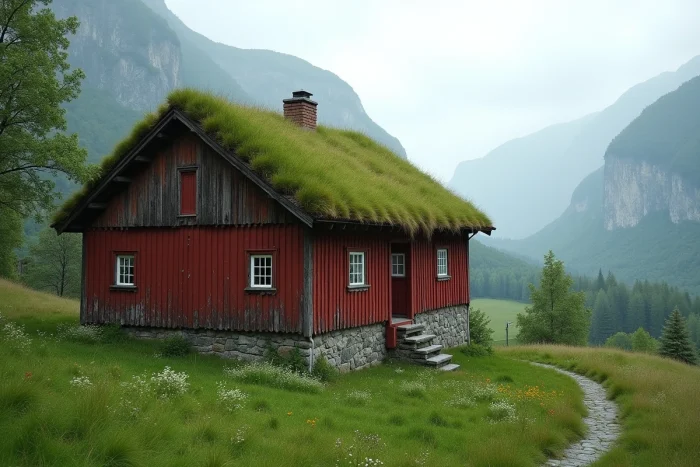
Norwegian green roofs are not a recent invention or an aesthetic whim. Their presence dates back to prehistoric times, long before the term “eco-roof” entered the vocabulary of sustainable architecture. Understanding how such an ancient technique has endured through the centuries without losing its relevance requires comparing what it provided to Viking homes with what it offers to contemporary passive constructions around Oslo.
Birch bark and peat substrate: the construction technique of Norwegian grass roofs
Most articles about grass roofs in Norway mention their beauty or antiquity. Few detail the layering of materials that makes the technique viable in such a harsh climate. During the Viking Age and the Middle Ages, nearly all houses had grass-covered roofs, according to a precise assembly.
The base rested on a wooden frame, often made of local pine. On top came several layers of birch bark, laid in an overlapping manner to ensure waterproofing. Birch bark contains natural oils that make it resistant to water and decomposition. This plant membrane played the exact role of current synthetic membranes.
On this protective layer, builders placed peat, including grass, in two crossed thicknesses: one layer with roots facing up, and one layer with roots facing down. This arrangement prevented the substrate from sliding down the slope and encouraged rooting. To delve deeper into the origins of grass roofs, it should be noted that this double-layer method remained stable from the Middle Ages to the 18th century, before tiles appeared in cities and on rural manors.
Traditional grass roof or modern green roof: a comparison of properties
Recent passive house projects in Norway reinterpret the grass roof with synthetic waterproofing membranes and calibrated drainage systems. The principle remains the same, but the materials change. The table below compares the two approaches.
| Criterion | Traditional roof (peat and bark) | Contemporary green roof |
|---|---|---|
| Waterproofing | Overlapping birch bark | Synthetic membrane (EPDM, PVC) |
| Substrate | Natural peat, double crossed layer | Draining mineral substrate, controlled thickness |
| Vegetation | Grasses, mosses, and spontaneous local plants | Sedums, selected mosses, sometimes grasses |
| Thermal insulation | Good in winter (mass of peat), variable in summer | Optimized to limit summer overheating and retain winter warmth |
| Rainwater management | Natural absorption, gravity drainage | Integrated drainage system with filtering layer |
| Lifetime | Regular maintenance required (mowing, bark checking) | Reduced maintenance, membranes guaranteed for several decades |
| Hosted biodiversity | Rich communities (mosses, lichens, alpine plants) | More limited biodiversity depending on the chosen substrate |
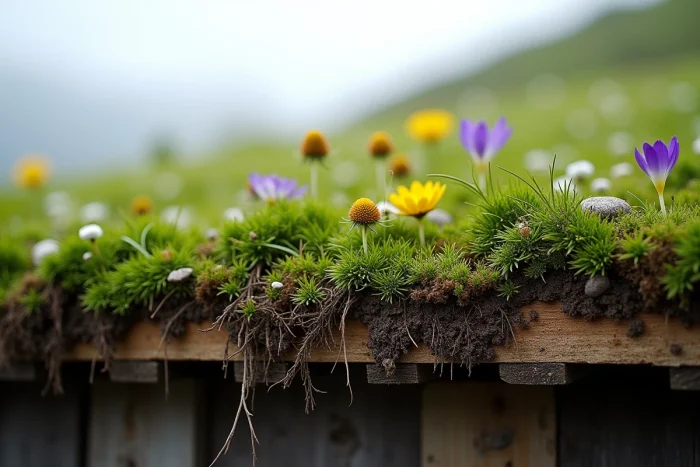
The notable point: on the criterion of biodiversity, the traditional roof significantly outperforms the modern version. Scandinavian researchers in urban ecology note that peat roofs host specific communities of mosses, lichens, and small alpine plants that are sometimes declining in ordinary meadows due to agricultural mechanization.
Rainwater management in the mountains: an asset against climate change
Norwegian mountain villages face increasingly intense rain episodes. Grass roofs, when renovated with a non-compacted and slightly deeper substrate, significantly reduce runoff peaks during these episodes. This is not a marginal benefit.
A classic tiled or metal roof directs all the water received to the gutters and the ground drainage system. In contrast, a green roof absorbs a significant portion of this water in its substrate before gradually releasing it. In rural and semi-rural areas where drainage networks remain sized for historical flows, this decentralized rainwater management prevents infrastructure saturation.
This buffering role explains why Norwegian sustainable development policies continue to support the greening of roofs, including on new buildings. Tradition here meets a measurable functional need.
Boreal biodiversity on roofs: a micro-habitat becoming rare on the ground
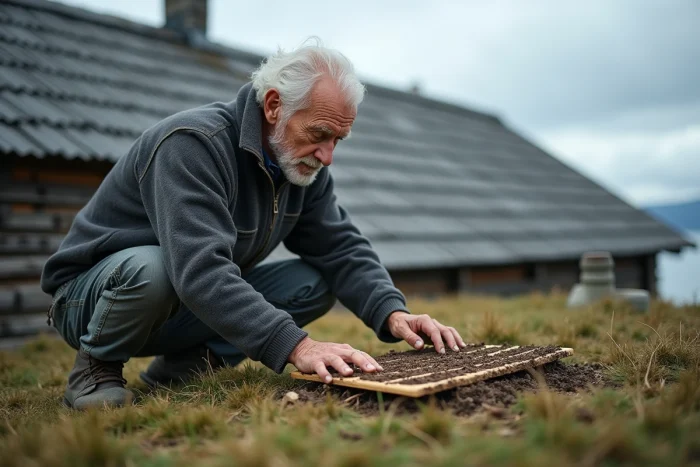
Grass roofs do not just insulate or manage water. They function as refuges for boreal biodiversity. Species of mosses and lichens that are losing ground in mechanized meadows find on these roofs a stable habitat, undisturbed by plowing or intensive grazing.
This ecological function differentiates the Norwegian grass roof from a simple ornamental green roof. Three characteristics explain this capacity to host:
- The peat substrate offers sufficient thickness for deep-rooted plants to establish themselves permanently, not just superficial sedums.
- The absence of chemical treatment on these traditional roofs allows the development of fungal communities and soil microorganisms that support the local food chain.
- The historical continuity of these roofs over several centuries has created ecological corridors at altitude, connecting vegetated plots that modern construction would otherwise have fragmented.
The preservation of these micro-habitats directly depends on the maintenance of the practice. Every abandoned grass roof reduces the ecological mesh available for these specialized species.
Thermal insulation of grass roofs: performance measured in a Nordic climate
The thermal argument is often put forward to justify green roofs, but it deserves clarification. The mass of peat and soil acts as a thermal buffer with high inertia. In winter, it slows down heat loss from inside the building. In summer, it limits the heating of the roof under solar radiation.
Passive house projects around Oslo and in southern Norway exploit this dual property. The greening of the roof is not their only insulation device, but it complements modern systems by adding a layer whose thermal behavior varies with the seasons and the substrate’s moisture.
In rural Norwegian areas, this technique was universal until the early 18th century. Its replacement by tiles in cities corresponded to a logic of standardization and reduced maintenance, not thermal gain. Mountain chalets, cabins, and holiday homes continue to use grass roofs because their performance at altitude remains difficult to match with conventional materials at comparable cost.
The Norwegian tradition of grass roofs has withstood the test of time because it simultaneously meets thermal, hydraulic, and ecological constraints. Materials evolve, but the constructive logic remains the same. The fact that contemporary architects are returning to this technique for measurable reasons, and not out of nostalgia, confirms that the relevance of these roofs far exceeds the heritage framework.