
Obtaining a visible grain on a wall or canvas is not a major technical challenge. Keeping it readable, matte, and stable over a long period without yellowing or dust accumulation is another matter. Most methods available online focus on the gesture or choice of medium but overlook the issue of longevity, which ultimately determines the final result.
Naturally Granular Pigments: A Film Effect Without Added Sand
The most direct approach to create a fine grain, similar to digital noise or film rendering, is to choose pigments whose structure is already irregular. Dark iron oxides, volcanic earths, and carbon blacks produce an optical grain without resorting to mineral fillers or sand.
This method has a concrete advantage for durability. A pigment that generates grain through its own granularity does not create a surface buildup. The layer remains thin, which limits dust retention and reduces the risk of flaking due to mechanical stresses in thick impastos.
Manufacturers of extra-fine acrylics are increasingly incorporating these pigments into their color charts, highlighting “visual noise” as a technical argument in their product sheets. To explore other granular paint techniques, combining these pigments with a matte binder yields a result particularly close to photographic grain.
However, not all granular pigments are equal when it comes to aging. Natural earths (ochres, burnt sienna) resist light well. Carbon blacks remain stable over very long periods. Some cheap synthetic oxides, on the other hand, may change color after a few years of direct exposure.
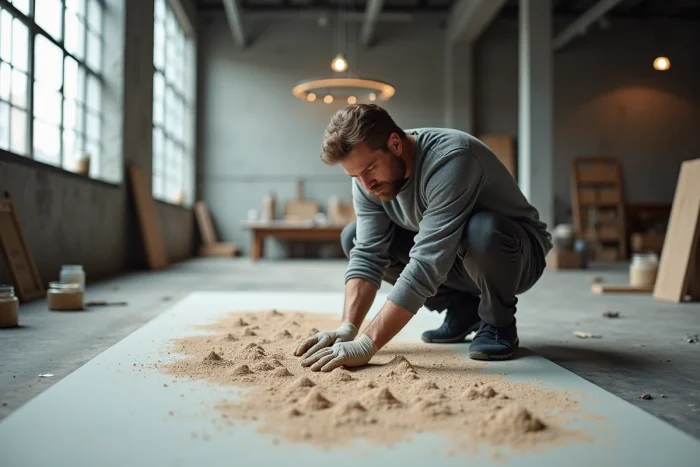
Baking Soda and Homemade Fillers: Real Limits on Durability
Baking soda frequently appears in tutorials as an accessible granular filler. When mixed with acrylic paint, it indeed produces a pronounced grain that is easy to dose.
The problem arises after drying. Baking soda is hygroscopic: it absorbs ambient moisture and can partially dissolve in poorly ventilated rooms. On a bathroom or kitchen wall, the texture can degrade within months, leaving irregular smooth areas amidst the grain.
For temporary decorative use or on a canvas protected by a matte varnish, this technique works. For a wall intended to remain as is for several years, field reports vary on this point, but the general trend indicates a significantly lower durability compared to inert mineral fillers (marble powder, fine silica).
- Baking soda: strong grain, nearly no cost, but sensitive to moisture and unstable beyond a few years without protection
- Marble powder: fine to medium grain, chemically inert, excellent longevity, compatible with acrylic binders and lime-based coatings
- Fine sifted sand: more rustic grain, suitable for pronounced sandy effects, requires a sufficiently thick binder to encapsulate each particle
- Micronized silica: very fine grain (photo film type), minimally visible in thickness, compatible with a matte finish without varnishing
Matte Finish and Preservation: Protecting the Grain Without Drowning It
A granular effect loses all its appeal under a glossy varnish. The reflection visually flattens the texture and eliminates the surface contrast that gives the grain its charm. A matte or satin matte finish remains the only coherent option.
The choice of protective varnish directly affects longevity. Water-based matte acrylic varnishes do not yellow, unlike glycerophthalic varnishes that gradually turn amber, especially in rooms with little exposure to natural light.
Applying the varnish in very thin layers, with a short-haired foam roller, protects the grain without filling the texture’s recesses. Two light passes are better than a thick layer that fills in the surface irregularities.
Dust Management on Textured Surfaces
The rougher a surface is, the more it retains suspended particles. On a granular wall, regular maintenance with a damp cloth is not always sufficient. A soft-bristle vacuum cleaner, used once or twice a year, prevents the gradual buildup that dulls the grain.
A fine grain retains less dust than a coarse grain. For living spaces, favoring a subtle granularity (like photographic film) rather than a pronounced sandy texture significantly reduces maintenance without sacrificing the visual effect.
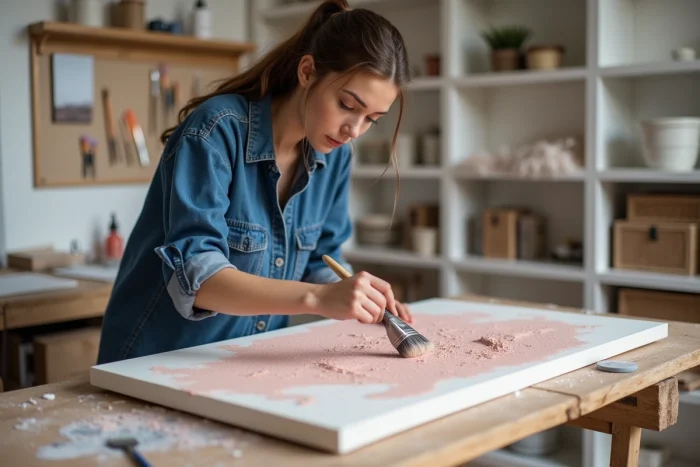
Masking Tapes and Graphic Contrasts: Treating Grain as a Pattern
Next-generation masking tapes, with low adhesive and ultra-sharp edges, allow for precisely delineating granular areas, transforming texture into a graphic element. Instead of treating an entire wall with uniform grain, alternating smooth bands and textured bands creates a visual rhythm that structures the surface.
This approach requires careful preparation. The tape must be applied to a perfectly dry smooth first coat. The loaded paint (granular pigments or silica) is then applied to the exposed areas. The tape is removed before complete drying to avoid material tearing.
- Apply the tape on a base coat that has been dry for at least a full day
- Apply the granular layer by pulling the tape toward the center of the textured area, never the reverse
- Remove the tape at a low angle when the paint is still slightly tacky to the touch
The final result depends as much on the quality of the tape as on the technique. Budget tapes often leave smudges that blur the boundary between smooth and granular areas, ruining the desired graphic effect.
A wall treated with this method of sharp contrasts ages better than a fully granular surface. The smooth areas facilitate cleaning, while the textured areas, protected by a matte acrylic varnish, retain their grain. The whole remains readable after many years without touch-ups, provided that the support has been properly prepared and the binder is suitable for the room.