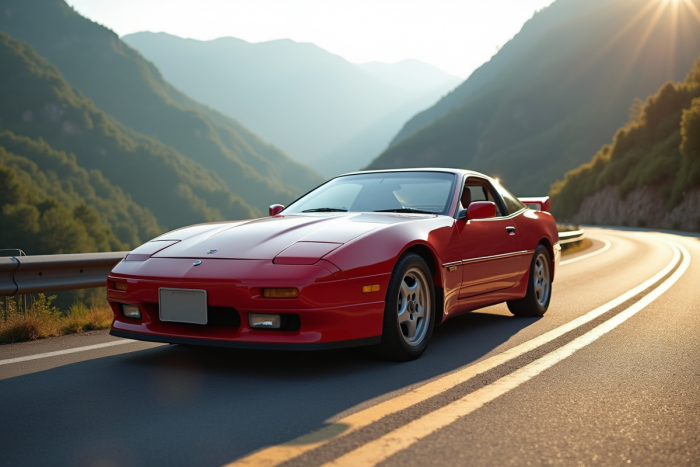
In 1989, a Japanese manufacturer launched a mid-engine sports car, permanently disrupting the hierarchy of high-performance coupes. At the same time, some major global brands began integrating turbo technology into their production models for the first time, even as the economic crisis loomed.
Despite strict regulations and cautious markets, a few models achieved unprecedented performance and established themselves as technical benchmarks, leaving a lasting influence on the automotive industry. These vehicles, now sought after, embody a turning point where engineering and automotive culture came together to shape a unique legacy.
Why Japanese Sports Cars of the 90s Made Automotive History
At the turn of the 90s, the global automotive landscape took a new direction. Japanese automakers shook up the codes of performance. Just mentioning the Honda NSX, developed with the collaboration of Ayrton Senna, illustrates the significance of this revolution: aluminum chassis, naturally aspirated V6 engine, surgical balance, undeniable reliability. Further down the road, the Toyota Supra showcases the power of its inline six-cylinder engine, combining mechanical endurance with extraordinary tuning potential. This wave of technical creativity reveals a passionate Japan, in search of innovation and precision.
It is indeed the most iconic Japanese cars of the 90s that paved the way for a new era, encouraged by the famous Gentleman’s Agreement among manufacturers. This agreement, capping power at 280 horsepower, did not stifle creativity; quite the opposite: it pushed for technical prowess, turbo optimization, mastery of onboard electronics, and transmission sophistication. Take the Mazda RX-7 and its rotary engine, or the Nissan GT-R R34, each has become a centerpiece for enthusiasts worldwide, a living testament to Japanese genius. Names like Mitsubishi and Subaru are not to be overlooked, demonstrating their expertise both on the road and on the track.
What explains this exceptional moment? It is the meeting of affordable maintenance mechanics, recognized reliability, and technological boldness that also dares in terms of style. The Japanese market then became a testing ground, elevating these sports cars to the status of icons of an inventive Japanese automotive industry, whose imprint remains visible in today’s automobiles.

From the Toyota Supra to the Honda NSX: The Legacy and Current Value of Japanese Icons
Today, the value of 90s Japanese collector cars is skyrocketing around the globe. The Toyota Supra, equipped with its inline six-cylinder engine, embodies a generation where performance was synonymous with durability. The Honda NSX, designed in partnership with Ayrton Senna, set a milestone: agility, precision, exclusivity. These cars are no longer just machines; they have become fragments of automotive history, objects of desire and transmission.
The current value of these models is surging, fueled by the 25-year rule that facilitates the arrival of rare models on American soil. Collectors are rushing to acquire the best-preserved examples. Limited editions and versions prepared by Nismo are soaring at auctions. The Nissan Skyline, Mazda RX-7, and Subaru Impreza STI are experiencing a spectacular resurgence of interest, their reputation firmly established on their mechanical endurance and low maintenance costs.
Here is an overview of the models fueling this phenomenon:
- The Toyota Supra: iconic engine, reliable value, appeal that crosses borders.
- The Honda NSX: technological feat, sporting heritage, sought-after rarity.
- The Nissan Skyline: prestige of the lineup, versatility, prized Nismo versions.
- The Mazda RX-7: uniqueness of the rotary engine, timeless design.
The Japanese market remains a reference point, both for the richness of its offerings and the remarkable condition of the cars. Japanese brands have firmly established themselves in the hearts of enthusiasts, each model telling its own story of technical audacity and creativity that marked the 90s. These sports cars continue to fascinate, far beyond nostalgia, as a promise of pure emotion for those who still marvel at the roar of an old-school engine.