An artistic preparatory year is a post-baccalaureate training program, typically lasting one year, whose primary purpose is to provide a technical and critical foundation before entering a higher education program in art or design. It does not confer a diploma per se and is not a mandatory step: candidates each year directly enter higher art schools after the baccalaureate or after entirely different paths.
Admission outside Parcoursup: a separate calendar that alters the application strategy
Most public artistic preparatory programs operate outside the Parcoursup platform. Each institution manages its own selection criteria, dates, and assessments. Some private preparatory programs, however, go through Parcoursup or offer open applications.
This duality creates a concrete difficulty for high school students. They must conduct two processes in parallel: compile a Parcoursup application to secure traditional wishes, while also preparing direct applications to public preparatory programs. The selection sessions for the latter can extend until the end of summer, well after the main phase of Parcoursup has closed.
Managing this gap requires anticipating as early as January. Choosing a preparatory year before artistic studies thus requires active monitoring of the websites of each targeted school, as there is no centralized calendar.
This fragmented operation has an advantage: selection relies more on the artistic portfolio than on academic grades. A motivation interview and the presentation of personal works often weigh more heavily than a final year report card.
Building the artistic portfolio: what the preparatory program produces concretely
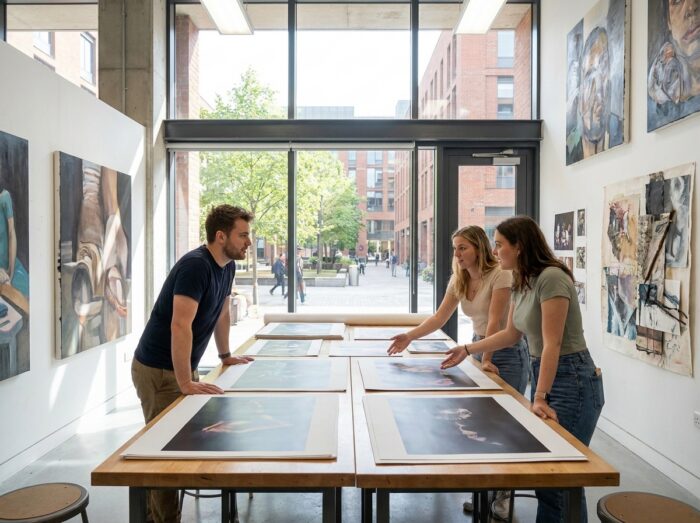
The artistic portfolio (or book) is the centerpiece of the entrance exams for higher art schools. Without a preparatory program, a candidate assembles it alone, with limited resources. With a preparatory program, they benefit from guidance that structures the process over several months.
The difference lies not only in the volume of works produced. It mainly concerns the diversity of mediums explored and the ability to articulate an intention. Teachers guide students towards techniques they might not have spontaneously approached: engraving, sculpture, photography, installation.
- Observation drawing is worked on as an analytical tool, not as an end in itself. Life model sessions develop the speed of gesture and understanding of proportions.
- Workshops in three-dimensional creation (modeling, shaping, assembling) force students to think about space and material, a skill rarely developed in high school.
- Writing exercises on plastic work teach how to verbalize a project, a skill evaluated during the oral exams of art schools.
A portfolio built in a preparatory program shows a progression and coherence that juries quickly identify. The pieces are not simply juxtaposed: they reflect a research process, a back-and-forth between intention and realization.
Artistic culture and critical positioning: the invisible foundation
The preparatory programs dedicate a significant portion of time to art history, analysis of works, and contemporary issues in design or visual arts. This theoretical dimension clearly distinguishes the preparatory program from a simple practical workshop.
Understanding why the Bauhaus articulated art and industry, or what land art changed in the relationship to space, is not merely decorative general knowledge. These references become positioning tools during exams. A candidate able to situate their work within a broader artistic field demonstrates a maturity that juries value.
The critical work also functions in the opposite direction. Collective presentation sessions, where each student presents their work to the group and teachers, train them to receive reasoned feedback and defend their choices. This habit transforms the exam oral into a familiar exercise rather than an unprecedented challenge.
Artistic preparatory program and orientation towards design or applied arts professions
One of the less visible effects of the preparatory program is the clarification of the orientation project. A high school student attracted to visual creation often hesitates between very different paths: higher art schools, BTS in applied arts, design training, architecture schools, or even careers in illustration or animation.
The preparatory program acts as a filter. By concretely testing graphic design, spatial design, video, or painting, the student identifies what truly engages them. This sorting avoids costly reorientations in the first or second year of a long program.
Alternation is generally not offered in artistic preparatory programs, which distinguishes them from other more professional post-baccalaureate training. This point deserves consideration: the preparatory year represents an investment in time and tuition fees (variable depending on whether the institution is public or private) without remuneration or direct professional experience.
- Public preparatory programs, often linked to higher art schools, charge significantly lower fees than private ones.
- The choice between public and private also depends on the targeted specialization: some private preparatory programs lean more towards graphic design or motion design.
- The cost should be compared to the risk of a lost year in case of reorientation after a poorly calibrated direct entry.
For a student whose project is still unclear after the baccalaureate, this year of decantation has a measurable effect: it transforms a vague desire into a structured application, supported by a solid portfolio and a clear intention. The absence of a diploma upon leaving the preparatory program does not change this observation: the value of this year is reflected in the integration rate into schools and in the strength of the subsequent path.