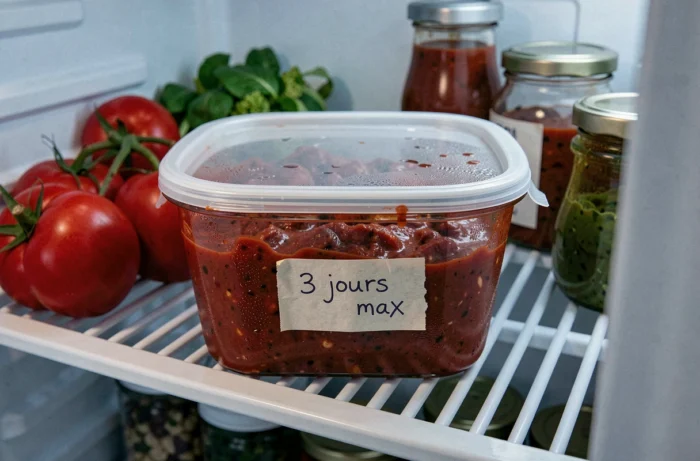
A homemade bolognese sauce, made with ground meat, tomatoes, and onions, does not behave like an industrial condiment packed with preservatives. Its shelf life in the refrigerator depends on factors that most recipes do not mention, starting with the speed at which it was cooled after cooking.
Cooling After Cooking: The Factor Recipes Overlook
The majority of online discussions about bolognese preservation focus on the number of days. However, the most crucial question lies in the two hours following the end of cooking.
A large pot of sauce left to cool on the countertop can sometimes take several hours to drop in temperature. During this time, the range between about ten and sixty degrees Celsius promotes rapid bacterial growth. Dividing the sauce into shallow portions speeds up cooling and reduces this risk window.
Specifically, pouring the sauce into several flat containers rather than one large one allows it to reach refrigerator temperature much faster. A half-filled Tupperware cools significantly quicker than a three-liter pot. This simple action sets the stage for everything that follows in terms of preservation.
The shelf life of bolognese in the fridge directly depends on this initial step, often rushed out of habit.

Storing Bolognese Sauce in the Refrigerator: The Real Guidelines
On forums, opinions vary. Some eat their bolognese after seven days without issue, while others throw everything out after three days. Field reports differ on this point, but food safety recommendations converge on a clear guideline.
A homemade bolognese sauce lasts between three and five days in the refrigerator, provided the appliance is set cold enough. The ideal temperature is around four degrees Celsius. A poorly set or overloaded refrigerator, where the actual temperature is higher, shortens this window.
Containers and Storage Hygiene
The choice of container is not trivial. An airtight container limits exposure to air and bacteria present in the refrigerator. Glass jars with a sealing lid or food-grade plastic containers with clips do the job well.
- Prefer shallow containers to maintain even cooling, even once in the fridge.
- Never return a reheated portion that hasn’t been consumed back to the refrigerator: each reheating cycle degrades quality and safety.
- Avoid dipping a used spoon into the main dish to serve yourself again, as saliva introduces bacteria that accelerate degradation.
Salt and vinegar sometimes added to the recipe slow bacterial growth, but they do not replace proper temperature storage. Relying on seasoning to extend preservation beyond five days is a risky bet.
Actual Refrigerator Temperature: A Common Blind Spot
Most households never check the internal temperature of their refrigerator. A small thermometer placed on the middle shelf costs a few euros and sometimes reveals surprises. An aging appliance, a worn door seal, or a refrigerator that is opened too often can display a temperature much higher than what the thermostat indicates.
Beyond five or six degrees, the safety margin decreases significantly. A sauce stored for three days in a fridge at eight degrees poses a risk comparable to a sauce stored for five days in a properly set appliance. The number of days alone is not enough to judge.
Sauces containing ground meat are particularly sensitive. Ground meat offers a much larger surface area for bacteria than a whole piece, which is why recommendations are stricter for preparations made with minced meat.
Freezing Homemade Bolognese: What Thawing Changes
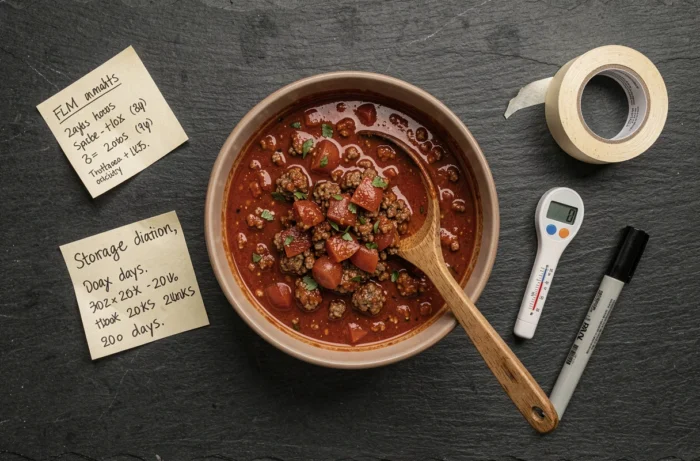
Freezing is often presented as the miracle solution for preserving homemade bolognese long-term. The sauce freezes well and can stay in the freezer for several months in an airtight container.
However, one point that is rarely specified deserves attention. A thawed sauce does not start from scratch in terms of preservation. The time elapsed between preparation and freezing counts. A bolognese made on Monday, stored in the fridge, and then frozen on Thursday has already consumed three days of its shelf life. Once thawed, it must be consumed quickly.
Thawing in the Refrigerator Rather Than at Room Temperature
The method of thawing directly influences safety. Leaving a container of sauce on the counter for hours recreates conditions favorable to bacterial proliferation. Thawing in the refrigerator takes longer (allow for a night) but keeps the sauce within a safe temperature range throughout the process.
- Transfer the frozen portion to the refrigerator the night before the planned consumption.
- Never refreeze a sauce that has already been thawed: each freeze-thaw cycle degrades texture and safety.
- In case of microwave thawing, consume the sauce immediately after complete reheating.
Signs of Spoilage: Beyond Appearance
A bolognese sauce may look fine visually while being unfit for consumption. The absence of a suspicious odor does not guarantee safety. Some pathogenic bacteria do not alter the appearance, smell, or taste of food.
Visible signs of spoilage (surface mold, sour smell, slimy texture) indicate advanced degradation. If in doubt about the cold chain or the number of days elapsed, caution recommends throwing out the sauce rather than tasting it to check.
The ground meat present in the bolognese makes this principle even more valid. Foodborne illnesses related to poorly stored ground meat preparations are among the most common in home cooking. The reflex “it smells good, so it’s good” is not a reliable test.